Thursday, September 02, 2010
Enterprise Social Bookmarking Neglected Stepchild
Via the ReadWriteWeb Twitter Feed i saw this post from Suarez on the The Business Case for Enterprise Social Bookmarking: $4.6 Million a Year in Cost Savings! .
 Nothing like throwing those kind of numbers to get someone interested in reading more. The numbers he references are from 2008, but i agree with the point that he makes that enterprise social tagging/ bookmarking keeps gets ignored but is still an important and rather critical part of a successful Enterprise 2.0 adoption strategy.
If you have been reading my blog for a while you know that i have always been an advocate of social tagging and in 2008 published an ebook on Hybrid Approaches of using Folksonomy (social tagging) and Taxonomy in the Enterprise.
Image|Flickr| AMagill
Wednesday, April 30, 2008
Photo Categorization Different Needs for Different Users

John Suler has an interesting project going on using Flickr about The CyberPsychology of Flickr and his recent addition was about Categorizing Images which came with the photo i include in this post. The project is to encourage discussion on how "people in flickr use photographs and images to express themselves, converse with each other, and form relationships as well as groups" and this addition was focused on how flickr users categorize their pictures.
In talking about personal 'taxonomies' he writes: "The categories you start off with may not work well later on. And the way you organize images for your own personal archive may be different than the collections you create for showing your images to others, as in flickr." In my world of taxonomies, we call this audience centric views- different audiences either by user type, location (e.g. US/UK), or usage purpose, etc.. Well built taxonomies allow this and robust taxonomy management tools enable this. Here is a paper on how the National Library Board of Singapore uses Audience-Centric Taxonomy: Using Taxonomies to Support Heterogeneous User Communities'
The other topic was Keywording for biology/taxonomy/nature photographers using Aperture which i have not used but seems to have a more robust keyword management tool allowing a hierarchy to be built. In the thread Stewart Macdonald highlights one of the things that for example content editors benefit from when a hierarchal taxonomy is presented that allows selection when tagging and that can also automatically expand the user-selected terms using related terms from their taxonomy system (and it does not have to exclusive of free text tags either!).
Stewart writes in response to someone who suggests that he just add keywords and then use search to find photos: "The hierarchy is important to me. If I didn't have nested keywords, I'd have to assign the following keywords individually to any pics of crocodiles:
animal
vertebrate
reptile
crocodile
Crocodylus
Crocodylus porosus
Being able to just assign 'Crocodylus porosus' and have all the 'upstream' keywords included too is a bit quicker.
I am always trying to find 'consumer' examples to illustrate concepts- that although might be different in a corporate environment still help the user understand some of the benefits- so these things and flickr- delight me.
Photo credit : jsuler
Saturday, February 23, 2008
Can Social Bookmarking Improve Search?

The report titled "Can Social Bookmarking Improve Web Search?" includes eleven experiments using del.icio.us designed to evaluate "different aspects of social bookmarking and their impact on web search". The main end results lead to the issue of needing critical mass which is still not here- the paper's authors estimate that only about on tenth of the web has been bookmarked and tagged in del.icio.us and therefore (at least when using only this domain) tagging is not yet ready to make a significant impact on search results.
However the report makes some interesting points that i highlight below that they believe can still be used to improve how search engines work.
- about 25% of URLs entered into del.icio.us are not seen in search engines for 4 weeks to 6 months after publishing. So one of the conclusions is that social bookmarking could be used "as a (small) data source for new web pages and to help crawl ordering.". I think that especially for niche vertical search engines this would make a huge impact- and could help them win traffic over the general search engines
- Users of social bookmarking sites are probably acting largely out of self interest rather than in concert. This means that their actions are largely uncoordinated. del.icio.us has relatively little redundancy in page information for perhaps 50% of URLs and high redundancy for perhaps 20%. Once again i think that bigger benefits could probably be seen in the vertical search space and SPECIFICALLY in the Enterprise space- where users tend to be more community and task focused.
- Tags might be able to help a search engine if tags can be matched to a user's query. This is applying traditional taxonomy search engine optimization models which have proven to provide great value. The report states that the tags that users are applying are on the whole accurate- of course the definition of 'accurate' is wholly dependent on the users and what and why the tag was applied to. For example, a tag of 'produce' could mean a banana or a command for the user- so when a user searches for bananas a work order to produce an art commission might come up so further disambiguation is the key.
- del.cio.us is already experimenting with including bookmarked results results as art of the Yahoo! search interface so it will be interesting to hear more about this from them
The last item that i thought was very interesting (and of course if you have been reading my blog for a while you will know why!) is this one conclusion around Domain tagging in which their recommendation is to 'pay' librarians to tag entire domains.
We also asked our users in our user study whether tags applied only to the URL involved or whether they applied to the entire domain. Our users said that about one in five tags applied not just to the URL in question, but to the domain as a whole. Both of these statements, both in terms of prediction and in terms of our user study suggest that a well financed search engine could pay "librarians" to tag entire domains rather than single URLs. Our broad conclusion was that paying such librarians would be more efficient, and might obviate the need for about 20% of the tags on URLs bookmarked.
Thursday, January 31, 2008
Socially Networked NewsRooms
 Here is an interesting experiment to create an Election News Network . Publish2 is a free online editorial platform for journalists, editors, and newsrooms. Scott Karp is the co-founder, President & CEO and he is also main author of Publishing 2.0 a blog that i am a fan of. I love Karp's attitude on whether the Elections News Network will work:
"Will it work? I dunno. It’s an experiment. We’re in beta. I could have called a committee meeting to commission a study into whether it will work. Instead we decided to JUST DO IT."
Over the years i have work with many media clients, many who unfortunately have had to do major cuts within their libraries and research centers that journalists relied on heavily for research on articles they were writing- many of these researchers served as 'networkers' potentially hooking up journalists that were working on similar stories. Over the last few years i have always brought up the idea that journalists would benefit for tools like social bookmarking, wiki like publishing, social networking (between journalists in big organizations for example) etc.
Publish2 seems to be a platform that enables this. From their site (i have not tried the service):
Publish2’s mission is to bring all of the world’s journalists onto one common web platform and community, one that empowers journalists to discover, organize, and rank the most important news — to benefit your own reporting, your newsroom, and all news consumers on the web. Publish2 is optimized for you as a journalist, combining online bookmarking, news aggregation, and social networking.
This post by Jack Lail 'Read What we Found' explains how Knoxnews.com plans on implementing it going beyond just their own journalists by picking top community bloggers to also make selections- i see this type of implementation like a controlled de.li.cious tag that only certain people are allowed to use on a domain and the more journalists bookmark a story, the higher it rises in the ranking on the site that publishes the 'widget'. Not sure if they can also leave comments on the bookmark but that would also be useful.
Will have to check back during and after the elections to see how this experiment goes.
Image attribution: cheesebikini.
Sunday, January 13, 2008
Resources from recent Webcast: Folksonomies and Taxonomies in the Enterprise
As part of the follow up i have created a Wiki for the community to participate and share with each other on the rather new topic of using both Folksonomies and Taxonomies in the Enterprise. From the Wiki you can also link to the recorded Webcast or the Slide deck that i have posted on Slideshare. I still have a lot to do on the Wiki (e.g. finishing the Q&A from the session)- but i hope that others will also assist in making the Wiki a useful place for those who are interested in the topic. If you know someone in the Enterprise that is looking into Folksonomies please send them a link to the Wiki (thanks!).
If this is a subject of interest, please be sure to check out the wiki and share additional resources or thoughts on the issue.
Many thanks to Lorraine Bell for all her assistance in coordinating this WebCast!
Friday, December 21, 2007
Additional support for APML this time from Ma.gnolia
 A nice holiday gift from the folks at Ma.gnolia with their announcement of APML support for their social bookmarking service. From the post by Todd Sieling, Ma.gnolia's product manager, they are using the Engagd service to allow Ma.gnolia members the ability to build an attention profile from their bookmarks.
 APML allows users the ability to compress all forms of Attention Data into a portable file format containing a description of their ranked interests- their Attention, based on what they are tagging in a service like Ma.gnolia can then be ported to other services that support APML. This will be a very powerful way to filter information from multiple services a user might use to consume information. As their Attention profile changes in aggregate from the various services they use, consuming services of APML are automatically updated and able to deliver exactly what the user wants based on their ranked interests.
In the annoucement post, Todd goes on to say "these are still early days for APML, and as such there aren’t a lot of service providers supporting it and even fewer applications that can make use of this data. So, the hope in providing it for Ma.gnolia is that it will help stimulate development of APML-powered services that can offer us new ways of looking at what we do as we travel the web".
I have been a member of the APML Workgroup since early 2007, and believe that APML will have a transformative hand in information filtering, so i agree with Todd that we are still in the early days but am excited and thankful about Ma.gnolia's addition to the list of other services that support APML including some big Enterprise players like NewsGator that i have commented before on.
Ma.gnolia is also an early supporter of OAuth, which the open API authentication standard and another of the dataportability.org open stacks specifications.
Right on- and thanks for the lovely gift!
Webinar: Folksonomies & Taxonomies in the Enterprise
 In January i will be leading a Webinar organized by the Dow Jones InfoPro Alliance about Folksonomies & Taxonomies in the Enterprise.
From the e-mail invite:
Enterprises today face a critical challenge: How to manage an abundance of increasingly complex and disparate information assets in an environment of constant change and technological complexity. How do you provide tools that your users are used to using in the commercial world in order for them to stay competitive and enable collaboration?
Results from a recent round table event on Folksonomies & Taxonomies that discussed these challenges will be shared as well other research work that has been focused on the topic.
Other topics to be discussed include:
* What is the business value of a taxonomy/folksonomy and how can you deploy a solution that will grow with the organization?
* What’s the impact of social networking tools on the enterprise?
* Which governance tools can or should be applied?
* How do you merge folksonomies and existing taxonomies – or should you?
* Some best practices and common obstacles
Date: Thursday, 10 January
Time: 11:00 a.m. US Eastern Time/8amPST
to register please follow this link.
If you have items that you would like for me to address or you that would like to share with the audience about your experiences with Folksonomies in the Enterprise space, please drop me a line at daniela{dot}barbosa{@}dowjones.com - thank you in advance!
Monday, November 19, 2007
Users Generate but eventually someone will have to play Editor
From Jarvis's post the position calls for:
Guardian Unlimited requires a keyword manager to look after the labelling of our content online to ensure that it is consistent with the needs of the reader and the editorial values of the Guardian and Observer. The role requires attention to the demands both of a considerable content archive and of a fast-moving news operation, and involves work across media; from text to cartoons, video to podcasts. It would suit either a journalist with a particular interest in archiving, or someone with a background in information science who possesses a keen editorial sense.
Media room Editors that are responsible for adding metadata to articles are nothing new-like the ones at The New York Times. As media sites begin allowing user generated tags it will certainly add immense value for their readers as well as for their own editorial staff since they can learn new terminology that their readers are using much quicker then the traditional methods. Media sites whose core business is to deliver news content however need a robust yet flexible standard taxonomy that drives the type of news that is being published. A combination of both types with 'Editor 2.0' editorial purview will allow a rich display of aboutness of the news content outside of the standard tags clouds and lists we are used to seeing when sites open up tagging to users and i am looking forward to seeing some of these implementations.
Interested in discussing a similar topic of Folksonomies and Taxonomies but focusing in the Enterprise space? Perhaps you can join us for an upcoming round table event.
Thursday, October 25, 2007
Tagging and Folksonomy reading from ASIST
Introduction: Folksonomies and Image Tagging: Seeing the Future?
by Diane Neal, Guest Editor
Full Text: HTML | PDF (Size: 502k)Why Are They Tagging, and Why Do We Want Them To?
by P. Jason Morrison
Full Text: HTML | PDF (Size: 96k)Trouble in Paradise: Conflict Management and Resolution in Social Classification Environments
by Chris Landbeck
Full Text: HTML | PDF (Size: 95k)Image Indexing: How Can I Find a Nice Pair of Italian Shoes?
by Elaine Ménard
Full Text: HTML | PDF (Size: 109k)Flickr Image Tagging: Patterns Made Visible
by Joan Beaudoin
Full Text: HTML | PDF (Size: 82k)
As i recently blogged this December i will be hosting a round table event to discuss Folksonomies and Taxonomies in the Enterprise - which will also include a tour of our printing plant in Palo Alto. If you are interested or know someone who is working in this space and would like attend, please drop me a line we still have a couple open seats. daniela{dot}barbosa @dowjones.com
Sunday, October 14, 2007
Folksonomies and Taxonomies in the Enterprise - Dow Jones Upcoming Round Table Event and Print Plant Tour
On Tuesday December 4th at our Wall Street Journal printing plant location in Palo Alto, CA we will be hosting a round table event for Enterprise practitioners that are looking to deploy or have deployed tools in their enterprise that provide tagging capabilities. The round table portion will be from 2-4pm and then from 4-5pm we will get an exclusive tour of The Wall Street Journal printing plant which I arranged thinking that it would be a nice 'old media' meet 'new media' type of activity.
We still have some spots open for the round table if you or someone you know is working in implementing in the Enterprise and i am also hoping to open the printing plant tour and cocktail hour to more people who are interested in discussing the topic with other attendees while taking a peak at printing plant (hey who knows how much longer these will be around for!)- so drop me a line if you are interested daniela[dot]barbosa[@]dowjones.com
Thursday, August 09, 2007
Social bookmarking comprehensive list and social bookmarking 101 video
The list also includes social news sites like digg and reddit that allow users to rank and promote content as well as a sub-category of social bookmarking sites with clipping features like clipmarks (which has a recent pairing with Forbes).
While cruising around the Mashable site i also found this well done video to use as an introduction to social bookmarking if you are trying to introduce the concept.
Tuesday, May 08, 2007
Subscribe to a 'Consumer Tag' Amazon launches RSS Tag channels
I have written about social tagging quite a few times and i am interested in the use within both consumer online applications like Amazon and within the Enterprise (plus one affects the other more and more as these tools are introduced into the marketplace). Back in January on Read/WriteWeb Alex Iskold wrote about the competitve advantage that Amazon could have if they leverage the power of the 'consumer tag' along with some of highlights of Web 2.0 functionality that Amazon is presenting to its users. In his post Iskold writes:
Amazon's infrastructure analyses and categorizes huge volumes of text on a daily basis. The output of these algorithms is a list of key phrases that uniquely identify any item (e.g. a book). In my recent post about recommendation engines, I suggested that these key phrases can be substituted by people's tags. It looks like Amazon will soon be in position to do just that. What this means is that Amazon is going to be able to do item-based recommendations for all its products, without having to analyze music, movies and houseware in the same way. This will be another big win for Amazon and a big competitive edge, since no other retailers have this.

With the launch of the Amazon's RSS Tag Feeds Amazon presents its users with new ways of consuming recommendation and crowd 'wisdom'.
From the Amazon help files here are some ways they are recommending for uses of tag RSS feeds:
- Subscribe to feeds such as quilting or murder mystery, to learn of new products related to your interests, hobbies, or favorite authors as soon as other customers suggest them
>>> cool so per my picture, if i wanted to see what product people tagged 'bob dylan' i will eventually be able to just subscribe through my RSS reader (not all tags are enabled currently). Sure i can subscribe to similar feeds through other social tagging systems- but none are very targeted to products that are for sale
- Embed a widget on your own website to automatically show the most popular products for a tag, such as wii games, and earn referral credit through the Associates program
>>> cool so i can embedd a crap widget on my site and make a crapload of money ;-)
- Create a special tag for your book or movie club and provide a feed of recommendations to your members
>>> ok this is getting more interesting and can be extended across many uses. For example conference speakers can use a specific tag to tag books for a specific conference. teachers can tag recommended books for class reading, etc.
- Export all your products and tags into another application or create your own web 2.0 mashup
>>>>Yes the beauty of RSS makes it easy to consume within other applications and with the growth of mashup tools you can probably make some interesting tools to monitor products both from the consumer and the vendor perspective. If you are monitoring your products for example you can create views for each product, displaying the words people are tagging it with, you can setup alert words (like 'crap' for example), see what competitive products people are also tagging with the same words, and you can even use it to discover new market opportunities.
Monday, April 09, 2007
We love Netflix and want to make it better

In this session, I interview Keith Deweese an avid Netflix fan (tune in to hear about his favorite movie~ hey i was surprised!).
Keith however is a taxonomist and a very good one to boot and he feels that Netflix could drastically improve its service by improving core website features like browsing, navigation and search for end users.
During the interview, we discuss how we think that the Netflix recommendation engine contest is great but feel that Netflix needs to first make some improvements to allow users to find what they are looking for- by following some standard information categorization practices and improve their service overall.
Keith is based in Chicago and i filmed this session in San Francisco using a Web Conferencing Tool, a conference phone and a wall projector (i couldn't get the video conference working but the first clip in which we do introductions has a great picture of Keith).
His blog post on subject can be found over on his Blogex Deweese blog. Thanks-Keith!
If you have specific experiences with Netflix that you would like to share on this topic feel free to leave a comment or a link to your response.
Sunday, April 01, 2007
Intelligent Agent Blog Review of Social Bookmarking Tools
The Intelligent Agent Blog written by Robert Berkman of Information today has a good review of free, public social bookmarking sites that could also be suitable for enterprise use. He reviews many of the services that have been out there for a while and also reviews some new ones that i was not aware of. In addition he posts that on April 15th he will share a full article, which also contains a detailed feature comparison chart of both fee-based and free social bookmarking vendors and sites. I am really looking forward to this article since i am working with a handful of customers that are starting to seriously evaluate social tagging as a solution for their enterprise.
Social tagging & bookmarking has great potential for not only helping enterprise users save, organize and share information with each other but for natural extensions like expertise location. I am confident that it will become a common solution for enterprises. Just this last week, Rich Hoeg from Honeywell announced the launch of Connect Beam's enterprise solution.
Friday, February 16, 2007
Enterprise 2.0- What does it mean to me (Part 1)
So i figured i would also share simple things i do that i consider Web 2.0 usage in the enterprise as well while i am at it- give and you shall receive i believe.
If you read through my blog posts you will find other types of 2.0 user scenarios in the enterprise, like social tagging and account planning in a Web 2.0 world that i talk about, some of these are more important then others in driving the enterprise business. If you read Andrew McAfee's definition of Enterprise 2.0 (which he is currently debating on his blog) - he defines Enterprise 2.0 as the use of emergent social software platforms within companies, or between companies and their partners or customers. So yes, the focus a lot of us think about when discussing Enterprise 2.0 is around the tools and applications "behind the firewall" (hey CIO insight just posted that Spending on enterprise social software will rise by 5.9% during 2007 ).
But there are various other ways that Web 2.0 technologies are influencing the enterprise and those are around consumer Web 2.0 applications that enterprise people are using to fullfill or enhance their work. I would like to believe that on a personal level the use of my blog is one way that i am personally using Web 2.0 consumer tools to my 'business' advantage. Here is another simple real life example:
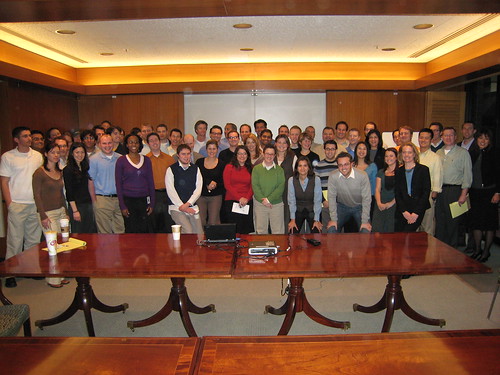
Yesterday, our Executive Vice President Clare Hart came to the San Francisco office to meet with the team and conducted a town hall meeting. In this meeting were people from the 10-13th floor that perhaps i have seen in the elevator but never really interacted with- they however are now part of my group in the Enterprise Media group which i am very excited about. So at the end of the town meeting, i made the request to get everyone together for a picture. Once i took the picture, i uploaded it on flickr and sent it around to the few people i did know or actually remembered their names (i am not so good at that) and asked them to forward to others for tagging. So what we created as a team, was a tagged map of who is who in the Enterprise media group at the San Francisco, Dow Jones office- a big family map. Useful for all of us - don't you think?
Click on this image to get to the flickr tagged version and hover your mouse over the image to see all the name tags.
Wednesday, January 10, 2007
2006 Post i made about Information Delivery and consumption in the Enterprise
While looking for those posts, i found myself reading some of the posts i published in 2006 on Information Delivery and Consumption in the Enterprise. I use Blogger for this Blog and they recently added tagging capabilities, so in 2007 it will be easier for me to find posts. Since last year that function was not available, here is a summary that i created for my own reference with high level subjects, hopefully the titles that follow the date of the post are descriptive enough and i apologize for the long URLS:
- RSS in the Enterprise
http://danielabarbosa.blogspot.com/2006/04/rss-in-enterprise.html
http://danielabarbosa.blogspot.com/2006/05/times-they-are-changing.html
http://danielabarbosa.blogspot.com/2006/11/rss-cleaning-leads-to-finding-new-hp.html
- Social Bookmarking/Tagging in the Enterprise
http://danielabarbosa.blogspot.com/2006/11/social-tagging-in-enterprise-podtech.html
http://danielabarbosa.blogspot.com/2006/10/social-bookmarking-in-enterprise.html
- Use of Blogs to understand your clients- http://danielabarbosa.blogspot.com/2006/07/openly-known-user-of-blogs-to.html
http://danielabarbosa.blogspot.com/2006/11/rss-cleaning-leads-to-finding-new-hp.html
- Enterprise use of Social Media tools (my definition at this point includes: blogs, video, podcasts,wikis etc.)
http://danielabarbosa.blogspot.com/2006/07/marketing-goes-web-20-why-dont-i-just.html
http://danielabarbosa.blogspot.com/2006/11/private-letters-turn-into-public.html
http://danielabarbosa.blogspot.com/2006/12/participatation-in-buying-cycle-instead.html
http://danielabarbosa.blogspot.com/2006/12/social-media-roundtable-round-up.html
http://danielabarbosa.blogspot.com/2006/11/power-of-communication-tools-at-our.html
- Sales in a Web 2.0 world
http://danielabarbosa.blogspot.com/2006/11/wikis-case-studies-in-enterprise.html
http://danielabarbosa.blogspot.com/2006/09/keeping-eye-on-your-customers-and.html
http://danielabarbosa.blogspot.com/2006/07/account-planning-in-web-20-world.html
http://danielabarbosa.blogspot.com/2006/08/web-20-strategies-understanding-your.html
http://danielabarbosa.blogspot.com/2006/02/death-of-cold-call-or-customers-you.html
And last but not least- last year's 'what i see in 2006' post which is right on target for what i did get to work on in 2006:
http://danielabarbosa.blogspot.com/2006/01/what-is-hot-on-my-list-for-2006.html
Monday, November 27, 2006
Social tagging in the enterprise podtech video
Connectbeam is not the only enterprise social tagging application out there and the long awaited IBM dogear tool is expected to come out next year and i have heard of enterprises successfully using open source tools like scuttle but from what i have seen and Puneet and i have discussed, i think they have a very good understanding of the Enterprise need- down to the fact that a tool like this needs to address the "what is in it for me" question that all enterprise applications struggle with as they get adopted
Our latest conversation was focused on sales users and the possibilities of an enterprise social tagging tool as a collaboration and knowledge capture system in the world of the Sales. Sure sharing is a bit weird (competitive pressures and paranoia) but when competing for the complex sale that may include an entire team within sales, marketing and product a collaboration tool like social tagging/bookmarking can easily show its worth. A couple months back i blogged about Account Planning in a Web 2.0 world- a simple use case for a complicated and what we all know as a tedious task that most sales teams do not enjoy doing.
One of those companies that has implemented social tagging behind the firewall is Mitre. I met Laurie Damianos at the Taxonomy Bootcamp last month where she and her colleague Donna Cuomo presented on a panel on "Social Tagging: Does It Work Inside the Firewall?". Back in May I had read Mitre's Social Bookmarking in the Enterprise white paper on a 6 month pilot and became immediately fascinated with the potential of social tagging in the enterprise. Laurie just recently sent me the updated version of this white paper 'Exploring the Adoption, Utility, and Social Influences of Social Bookmarking in a Corporate Environment'. The paper has been accepted for presentation at HICSS, the Hawaii International Conference on Systems Sciences in January 2007. The paper has not yet been published anywhere but will be available electronically through the conference proceedings in early January. Laurie was kind enough to share the results with me. i am not sure if i can blog about it so i will wait till it's published because their are some very interesting patterns and results that the Mitre organization found.
Sunday, October 29, 2006
Social Bookmarking in the Enterprise- bridges being built
 Last week i posted some thoughts about Social Bookmarking in the Enterprise which once again lead to some interesting conversations internally with some of my colleagues, in my comments section and at three different client meetings. I love the fact that i can blog about things that interest me and i feel are important to think about in the Enterprise information delivery space and folks will join the 'conversation' in whichever format they feel comfortable with. Good to see the Blog at work!
I was just checking out Emanuele Quintarelli's blog InfoSpaces and saw this post as a follow-up to the ASIS&T EuroIA conference. Emanuele has one of those cool Web 2.0 job titles at Reed Business Information. The presentation was on 'FaceTag' and they have the slides up at Slideshare. What they are trying to address is:
A middle ground between the pure democracy of bottom-up tagging and the empirical determinism of top- down controlled vocabularies. A new metadata ecology which merges and leverages emerging and traditional tools to improve findability and user experience.
While looking at the ASIS&T site i noticed that the BBC had done a poster session at the conference as well on this subject- a little more digging found me this piece in the November Bulletin about their changing approach to Metadata which presents an interesting overview of how they are approaching the bridging of the traditional and new social tagging tools.
I just RSVP'd for this week's SF Tech Sessions event because the main theme this month is SocialBookmarking and i am sure to learn something as well as meet some folks that are very interested in this topic.
Sunday, October 15, 2006
Collaboration in the Enterprise- take 1 Social bookmarking
How do we get people to collaborate and to sustain levels of collaboration throughout their careers at an enterprise? What is in it for them? What tools will the new digital natives coming into the enterprise need to be successful and how can we grab the knowledge that is about to walk out of the door with the baby boomers? These questions aren't new but what is being described as Web 2.0 in the enterprise could possible be a new way to try to address these issues.
Back in May i posted about social bookmarking in the Enterprise that lead to some very interesting conservations and the topic of social bookmarking in the enterprise has remained high on my list . Last week, while getting a tour of the tool, I had a chat with Puneet Gupta, CEO of ConnectBeam a new player in the social collaboration enterprise space.
Some folks in the Enterprise shriek when they hear terms like folksonomies- which can be one of the outputs of a social bookmarking tool. I don't claim to be an expert. LibraryClips has a good collection of links that addressed this topic last year that you should look at if you are interested in the folksonomy-taxonomy discussion. I spoke to Puneet Gupta and he certainly doesn't come about as someone who believes that Connectbeam and other tools out there that are targeting the enterprise are looking to replace enterprise taxonomies-augment them, yes- make them more valuable, yes- drive collaboration, yes.
From what i heard, he like others are trying to build a 'passable bridge' from what people are calling enterprise 1.0 to enterprise 2.0 (yeah don't wince)- workers do it on a daily basis with the tools they are turning to (like enterprise wikis and blogs that continue to be 'mashed-up' with enterprise applications)- Enterprises can't fight that and an enterprise metadata tool (or whatever you want to call it) that is able to take both worlds could be the needed suspension cables that flex the bridge when the wind blows yet keeps it passable and solid bi-directionally. As Peter Morville states in Ambient Findability (pg.139) "Ontologies, taxonomies, and folksonomies are not mutually exclusive. In many contexts, such as corporate web sites, the formal structure of ontologues and taxonomies is worth the investment. In others, like the blogosphere, the casual seredipity of folksonomies is certainly better than nothing. And in some contexts, such as intranets and knowledge networks, a hybrid metadata ecology that combines elements of each may be ideal."
Let's imagine that social bookmarking in the enterprise will take off and become accepted and widely adopted and then let's look at some of the disadvantages of Social bookmarking listed in Wikipedia. Then think about how established processes and tools can augment end-user collaboration tools like social bookmarking. The disadvantages listed include:
- no standard set of keywords (also known as controlled vocabulary)-
- no standard for the structure of such tags (e.g. singular vs. plural, capitalization, etc.)
- mistagging due to spelling errors
- tags that can have more than one meaning
- unclear tags due to synonym/antonym confusion
- highly unorthodox and "personalized" tag schemas from some users
- no mechanism for users to indicate hierarchical relationships between tags (e.g. a site might be labeled as both cheese and cheddar, with no mechanism that might indicate that cheddar is a refinement or sub-class of cheese)
-can a taxonomy co-exist with a 'folksonomy' that is user produced through an enterprise social bookmaking tool?
-what would (or does) that look like?
-what would the role of a taxonomy/ontology/metadata 'manager' or similar roles look like?
Monday, July 17, 2006
Account Planning in a Web 2.0 world
i have posted about Web 2.0 in the enterprise before and many of my posts revolve around things like OS from everywhere and social bookmarking in the enterprise space. During my day job, i typically look at the external information as used across a variety of different groups in the enterprise. Basically my elevator 5 second pitch is delivering the right information to the right person at the right time- when and how they want it- how? with an information delivery strategy into the users' everyday tools.
In the last year i have spent a lot of time with sale operations folks who are tasked with making sales people smarter, better and faster....so they can make...yes you guess it...more money. They might give them different titles like Account Managers at banks or Account Executives at a high tech firms or even consultants, but they all are looking for the same thing- how do we help our sales team know their customers, industries, triggers, competitors etc. and facilitate decisions and action based on that information?
One of the integration points that i think is extremely important and where the power of web 2.0 application will be felt, is in the Account Planning process. Account Plans are typically part of enterprise sales processes, most of the companies i run into have them- some implemented successfully (the sales teams benefit from the creation of them) and others not so successfully-(management makes it another administrative duty with little to no value for the sales staff). i believe that with web 2.0 - the notion of account planning- or strategically thinking about your sale can change and the account plan will become a 'living document' that travels with the sales team wherever they go- not owned by one but shaped by many.
In today's meeting we had a discussion that i have been having over and over again about automating the account planning process. Something i have delivered before- identifying the external data fields that apply to a specific section of the Account Plan(AP)- and facilitating the input of that data into the AP- which can be in a Word document, a CRM system etc. With Web 2.0 features, an account plan can even grow beyond that and follow the user as they journey across resources available to them to build a strategic winning plan:
- internal marketing sites } reviewing product specs that marketing have posted- and adding it as a 'note in reference' in your AP
- internal competitive intelligence web sites } reviewing your competitors offerings as related to that account - and adding it as a 'note in reference' in your AP
- internet websites } searching and browsing for information about the client, their products their customers -- and adding it as a 'note in reference' in your AP
- blogs } reading client's corporate and employee blogs - and adding it as a 'note' in your AP
- e-mails } receiving, sending , deleting- - and adding it as a 'note in reference' in your AP
- internal documents } finding other proposals for clients in the same industry with similar issues-- and adding it as a 'note in reference' in your AP
A couple weeks back i did a presentation for a client, where i discussed using web 2.0 functionality to do exactly what i outline above. I mocked up a quick page for that discussion modeled after services like Kaboodle-(see below) essentially a Sales Account planning 'cart' if i may call it- that quickly allows the user to add it to a specific section of the AP (a structure sales process needs a structure format), allows for user notes and even tags and is easily shared with other team members (and management) on demand from wherever they may be.

The end result- if that is what the company is looking for is a well defined document- probably in Word or in a PDF format- but the act of creating that document is from a contextual bookmarklet type of application that follows the user- storing the knowledge that the sale person gained in 'real time' during their journey and straight into the corporate memory.
