Thursday, October 18, 2007
Value of Common Metadata Schemas
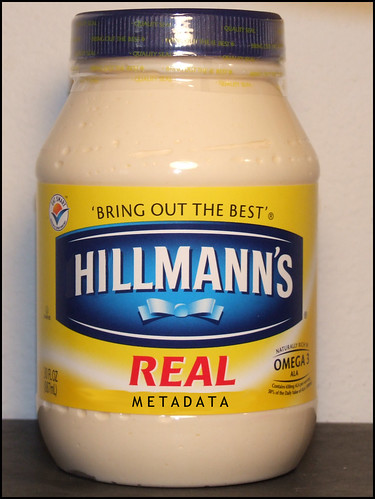 This post's topic first came up on my 'to blog radar' when Ian Kennedy blogged about Mining the New York Times Archives a couple weeks back pointing out that NY Times online articles (who recently opened their archives for consumers) came with rich Metadata within each article. Metadata tags like bylines, what people the article was about, the company, the region etc. that can be used to build applications that display/deliver content.
Dave Winer's smart little script to track NY Times article key words and his orginal post in which he asks basically for a standard in news content Metadata (well he wants to look at the NY Times taxonomy which he states could be a standard) prompted me again this evening to think about the value of Metadata in dealing with media content overload.
Like Ian points out in his post, because he used to work with me at Factiva he know quite well that the New York Times along with many of the 10,000 sources we aggregate send us content that is rich in this type of Metadata. The Metadata they send is usually based on an establish taxonomy that the Information Provider (IP) uses in their own content production process and many a time it is still hand coded by the editorial staff- although big media companies or consolidated services do also use automatic categorizers.
So before i go any further let me define one thing- Dow Jones produces content, the Factiva division is basically an Aggregator- we take over 150,000 articles per day from thousands of news providers through our source processing process and apply structured Metadata to each article which you can learn more about in detail in this white paper. During that process we normalize all the content into a standard XML format and add additional Metadata to each article as i describe below.
The content goes through various steps to ensure that the Metadata applied is useful downstream. So there are Metadata fields like 'author', 'date' and 'source name' etc. that we expect the IPs to send us that is fairly straight forward and we have mapping tables to figure out what each IP calls each field. There are also fields that are automatically calculated that can not be disputed like for example 'wordcount' and 'language'.
Then there is Metadata that describes the 'aboutness' of the article. Some Metadata that addressed the 'aboutness' of the content we map from what the IPs provide us for example the NY Times might send us an article that they have tagged about Russia- we 'trust' the NY Times coding so we apply our 'Russia' region tag to it.
The rest of the 'aboutness' is applied as Factiva Intelligent Indexing (FII) which is Factiva's core taxonomy- that covers Industry, Subject, Region and Companies (more detail on its application here in this white paper). There are also a lot of additional Metadata elements such as people, brands, products, organizations, parts of speech (e.g. a quote) that can potentially be extracted from the content as well.
So as online media providers open their archives i always get pings from friends and family about what that means for the Factiva 'business'- i always point to the value of the aggregation, normalization and Metadata additions to our content that covers 22 languages. In addition we also provide many services to help Enterprises deliver that content to the users that need it including licensing our taxonomy or helping clients build their own.
Winer's call for a taxonomy standard that is maintained by the public specifically for News is an interesting one and one that i thought about as a good use case for Freebase perhaps as more content is made available and more tools are made available for users to create delivery mechanisms through mashups.
Afterthought: After i shut down the computer last night, i kept thinking about this. There is no reason why if you are a ubergeek like Winer or Ian and have access to Factiva services in your enteprise you can't build things like this or even cooler- get in contact with me if you are interested i am looking for crazy ideas ;-)
photo attributed to denverjeffrey
Monday, August 20, 2007
Finally- The Social Media White Paper “Tracking the Influence”
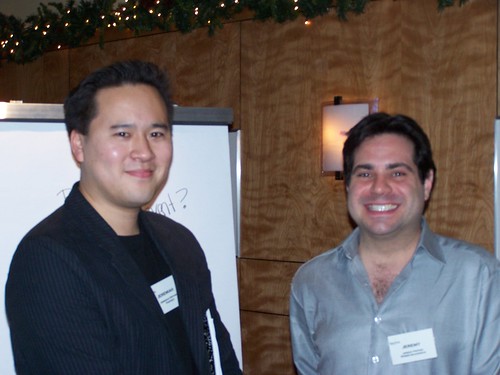 At the end of last year, I worked very hard alongside some colleagues at Factiva (Dow Jones) to coordinate a roundtable event to discuss Social Media with thought leaders in the Bay Area. The thought to have the roundtable came to me after speaking with Jeremiah Owyang and sharing my frustrations with the fact that every time i met up with people who were talking about Social Media, I always wanted my Factiva Insight product folks in the room- to listen and participate in those conversations. So what i managed to do was bring them West using a combination of social media itself (i blogged, reached out to other bloggers via comments etc) and good old fashion networking (i went from pub to pub in San Francisco- seriously i am not kidding) to engage members of the community that i knew would make great participants. We also reached out to a handful of local clients that we knew where dealing with these issues internally.
The location was a wonderful place called Zibibbo's in Palo Alto, CA where the food was incredible and the wine nicely poured...and what a great crowd we managed to get.
What were some of the questions we were/are trying to answer during this roundtable ?
- Do you believe Consumer Generated Media is important and should be measured?
- Who is creating Social Media? What are they creating? And is the who more important then the what?
- If you are producing Social Media as part of your PR/Marketing plan, how will you measure ROI?
- Do you think that Social Media needs a structured, mutually agreed upon measurement techniques and metrics (e.g. MSM's ad value equivalence and article impressions) to make monitoring a more serious practice?
- So what should be measured, and how do you want it delivered?
One of the agreed outcomes of the roundtable was that we would produce a white paper of the information that we gathered along with our co-author Jeremiah Owyang. Well for months and months i have been bugging (read harassing) Marketing about this white paper and when it would be finalized. Well as you know, Factiva has gone through a lot of corporate changes- we officially became Dow Jones in January and then five months later the news about the News Corp acquisition- well i guess they have all been busy. I am sure i have made more then one enemy being a pestering little bug- oh well i hope we can make up soon.
So the final outcome is this report authored by Matt Toll of our Marketing group and Jeremiah Owyang. You can Download the Report here: “Tracking the Influence” (PDF).
Since the event- many of the participants have continued to talk and address issues of social media measurement- some of the companies that participated have implemented strategies that they continue to refine. The white paper has some good thoughts and ideas by the participants and we hope that their voices are heard. As Jeremiah describes it, the white paper serves as a good primer for those that are new to the concept, or for those who need to start deploying a program but also provides a good insight into what was going through on minds on that day in December of 2006.
Additional information about the roundtable is available on the Factiva Roundtable wiki that was used to coordinate the event and provide a place for reflection afterwards. More pictures from the event here and shortly if i ever get to re-re-encode my video files i will post video clips of the participants.
and some final words?
Thursday, August 02, 2007
My Blog is being Feature on the Dow Jones Client Solutions Customer Newsletter
 I have been blogging since i made made my trek across the country when i moved to the Bay Area in February 2005- it started out as a way to keep in touch with family and friends and then i found myself blogging to keep in touch with my former East coast clients to share with them the things i was seeing on the West coast. Quickly my blog turned into a good way to communicate with my new clients on the West coast, the tech community, my company co-workers around the world and a way to completely bore the hell out of my friends and family who were expecting pictures of me surfing and living the San Francisco lifestyle but instead have to read about Web 2.0, social media and general grumblings about information delivery in the enterprise.
There are certainly other work colleagues of mine that are 'business' bloggers but none of us are currently under a Dow Jones domain- they are personal blogs that address business issues and trends that we are all interested in. When i started blogging, i was part of Factiva which at the time was a Dow Jones & Reuters company and had a blogging policy and even a CEO blogger.
At the end of last year, we became fully owned by Dow Jones and one of the first things i asked our PR department was about the DJ blogging policy. I am still waiting for an official Dow Jones blogging policy but was told to follow the employee code of conduct as a rule (honestly i think that all companies should have an official blogging policy and have been ancy about not having one over the last 8 months). If you are a regular reader of my blog, then you know that i try not to talk much about the Dow Jones corporate business or try to be overtly pushing products that we sell- for example i have hardly touched this News Corp situation on this blog (i have however Twittered about it but that is a closed network of those i consider my trusted friends some which are also clients).
The other day i was talking to my friend Jeremiah Owyang as we were coming out of a Social Media club event in which he had just been on a panel on business blogging in the enterprise. I told Jeremiah that our Client Solutions marketing group was producing a new quarterly newsletter and they had informed me that they wanted to highlight my blog. It has also been featured on the InfoPro Alliance newsletter that Factiva produces mostly for their information professional audience. Jeremiah thought it was great that Dow Jones trusted me enough to publish my site to their customers, but since he has been following my blog he can understand why the content i produce is valuable to the organization- i think it is pretty cool as well that they trust me.
Just today at the New Tech Meetup in San Francisco- where the topic was Women in Tech- Lorna Li asked me what i blog about- my standard response is that i blog about information delivery in the enterprise and it is a way for me to be part of the community that discusses issues important to that market segment while connecting with customers.
i don't get paid extra to blog about things that might bring revenue to the company or induce engagement with communities of importance to us, i do it because i truly enjoy it and it brings me immense pleasure when a customer or colleagues say to me- yeah i want to talk to you about that post about bla bla bla or i have been looking forward to meeting you- your blog is very interesting especially that post about bla bla bla.
I like think of myself as a corporate blogger that is trying to fit the Community/Evangelist Role that Jeremiah commonly speaks about- but i certainly feel that i could be doing much more. Part of it is time constraints and being overworked- i can't tell you how many times i come home with a great idea post that i start to write and then get wrapped up with some work project or simply run out of steam to continue thinking about work- so i try to pay myself and tell myself that i am blogging here for daniela not for Dow Jones- they are just one of the beneficiaries.
But the bottom line is that i am proud that my blog gets highlighted in a corporate newsletters from Dow Jones- it is through Social Media (my blog) that as an employee that is not at the executive levels that typically gets the public ear through mainstream media- I am able to communicate with the marketplace- i just wish i had more time to do it because it seems that almost everyday i say to myself 'if only i had the time to blog about this...'.
Oh yeah and something else to worry about-let's see if News Corp has a corporate blogging policy....if not maybe i will just convert this blog to focus on delivering information to enterprising cats.
Sunday, July 15, 2007
Community Next- Viral Marketing
 Yesterday i attended the Community Next- Viral Marketing event in Sunnyvale. Jeremiah thought the folks there were hard core because it was a beautiful day out- since i live in Pacifica even being indoors most of the day but having the luxury of walking outdoors for lunch and snacks made it a good reason to go.
Overall a good day and you will have to read through the end to get the tutu picture reference.
Some tips from the panels on viral marketing:
- target Hollywood media (music, movies etc.)- they have a built in audience and will drive users
- target politicians, especially during election races- another built in audience- allow your social media tools to help them spread their message. their constitutes will use the same tools to 'promote' themselves and their causes
- One of the top reason that viral services take off is the users like tools that let them do self-expression- accessorization of their user created content is hot
- When thinking about developing for Facebook Apps- consider how the user experience will be viewed within the Facebook news feeds which is where a lot of growth comes from
- Use tools like web-conferencing to test your target market- watch them click through on your beta site, see what they miss, what they click on etc. be agile enough to make changes based on real time usage
- if your service is a way for users to interact with others, or if your growth is going to be from them 'inviting' their friends- build in things like automatic upload of their contact list for sharing and building the community
- if you find people 'teaching' others how to use your tools (PBWiki talked about how educational users were doing seminars on using their wikis)- reward them by fueling the fire- they will be your spokespeople around the world- create presentation material they can use, send them t-shirts, premium access accounts, etc. 'Employee' your users.
- We already do a good job of this with our Factiva Insight products which do media monitoring and measurement by providing access to the tool to journalists, commenters and others. My colleague Melanie Surplice in PR usually highlights some of those on her blog.
- I constantly see blog posts (i have a couple searches on the term 'factiva') by librarians that write about finding something awesome in the database or even how they teach people how to use the factiva service- make them factiva 'divas'- send them a t-shirt, have them work with you to create training materials etc.
A couple of additional things i would like to comment on from yesterday:
1. boys- learn how to do presentations- presentation skills are important- engage, flow and message and if you have to use a PowerPoint slide deck use it well....
2. i call them boys in #1 above because I was also a bit disappointed (ok maybe more then a bit) that there was only one female on all the panels. Interestedly enough some of them spoke about the target market audience of viral application being young women- making some comments about how they sit around in a Tutu reading Cosmo magazine trying to figure out how to market to them.
Great Tutu photo credited to ambrosialove
Monday, July 09, 2007
Video Aggregation and Search for the Enterprise Information Worker
Yesterday Jeremiah posted some interesting predictions on Google and online video that is worth a read, especially if you are interested in the consumer space and video advertising- i however would like to expand on one of his points which is the video search space- with a focus on the enterprise information worker.
Last week i blogged about how Context and Aggregation are King- in the new business media world, and touched upon the importance of being able to get to video business content which may include relevant video and audio information from business news sources, CEO interviews, executive speeches, shareholders meetings, and product reviews to name a few that would be of interest to corporate users. There is obviously an explosion in high value video content- produced by both new and old media outfits- that enterprise users need easy access to in order to do their information work.
There is also a visable maturation of multimedia search engines like Blinkx, Nexidia and EveryZing/Podzinger that go beyond what most of the major search engines do to search video, which is still mostly text-based searching relying on titles, descriptions and tags and not searching inside the multimedia content.
During our meeting this morning, one of the benefits that i brought up that Factiva is doing with our new multimedia enhancements, that is different from the consumer video search space is that we are serving up video content that is relevant to business users along with other types of content- much like our core business to distribute only the best business news content and the best blog business content (although we do have solutions that actually throw a very large net- i am only talking about end-user research tools). In addition to the aggregation we are also adding additional metadata about that content and using visualization to provide additional information to the user on what the search results are (click image to see sample screen).
 The new features will leverage EveryZing's (PodZinger) speech-to-text and natural language processing technologies that enables users to surface short, targeted clips around specific search terms where they can subsequently view only relevant sections or the entire episode. It includes both video and audio. It also uses the Factiva Intelligent Indexing ™ and displays results in charts and graphs so that users can immediately extract value and understanding from their search. This is based on our Search 2.0 technologies that Lou take us through in this video from the FAST forward conference. Going against the results set the discovery pane presents metadata elements like what company, news subject and industry the videos are about- clicking on each item drills down to other results that were tagged the same.
I remember not so long ago when i was very vocal with the product folks that we needed to look at video and audio content and provide the same aggregation value to that content that we do with the text based content- i am pleasantly surprised and very pleased as to how quickly they managed to put this into the product enhancement cycle- congrats folks.

Oh yeah- and Jeremiah- we now got some Podtech content as well- ;-)
The enhancements are due in August- if you are not a Factiva subscriber but would like to preview it when it goes live- drop me a note at daniela.barbosa [at] dowjones.com
Tuesday, June 26, 2007
Context and Aggregation are King- in the new business media world as well
From the report some interesting stats on User Generated Content first:
"User-Generated Content (UGC) Is Not a Fad . . .
Some investors remain skeptical that UGC is more than a passing fad. However, in our recent online video survey, UGC is the No. 1 and No. 2 most popular content category among men aged 18-34 (M18-34) and among all respondents, respectively. Moreover, if we define UGC as page views only from sites such as Myspace.com, Facebook.com, Youtube.com, Wikipedia.org, Blogger.com, and Digg.com (which is quite conservative), we estimate that UGC now accounts for 13% of total U.S. Internet traffic, up from 0%-1% in 2004. Based on these statistics, we submit that UGC is here to stay."
Throughout the report there is a lot of information on the media producers themselves and how they are dealing with the explosion of video. The report has a focus on entertainment but with more and more 'news' outlets producing video some of the same issues and opportunities occur with business content which may include relevant video and audio information from business news sources, CEO interviews, executive speeches, shareholders meetings, and product reviews to name a few that would be of interest to corporate users.
From the report "apparent to us that as supply of video content rises, value will shift from content producers to aggregators and packagers of content that can best aid users in finding content that fits their specific interests".
Earlier this month when Dow Jones announced a partnership with PodZinger (now called EveryZing)to integrate audio and video content into Factiva products i was really excited exactly for that reason- adding metadata to that content set, providing context around video, audio and print is part of the value aggregators like Factiva provide.
Sunday, March 04, 2007
Freakonomics Authors Ask Why isn't the Wall Street Journal Free Online
If you look through most posts, the authors are truly engaging their audience constantly asking questions and eliciting a lot of responses from their communities (and you have to register with WordPress which probably leads to a more engaged commenter?). That is why i found this post by Levitt questioning why the Wall Street Journal Online isn't free an interesting read- not because of what Levitt put out there as a question (that debate is constantly on-going in and out of the blogsphere and the real water-cooler where i work)-but what is interesting are the comments that his readers posted in response. Some interesting points they made:
- A reader post a link to Mark Potts' recent 'Paid Content' post - focus on unique content and figure out a why to charge for it. Some figures are presented on that post about how the NYTs and the WSJ are going about it
- Many companies budget for access to premium content (in print or online) because it is an 'investment rather then entertainment' and is 'the paper of record'
- Like the fact that Freaknomics the book (and probably the blog) is highly used by university students, the WSJ like the Financial Times (FT) is required reading for those students and many carry that 'habit' into their careers
- Interesting comment about business travelers and their reading habits- i personally enjoy reading the local paper when i am in a different city and hate the fact that USAToday is defaulted as the paper delivered (most big city hotels will deliver the WSJ or FT if requested)- (online USAToday is also changing)
- Comment about local papers having to stop being reprints of AP newswire stories and have them focus on local news
And last i would like to point to one comment about access of these publications through the Factiva services. " Well, now that I’m a poor grad student, I guess I can get it for free from Factiva, but it’s really a pain to read any news source that way… it’s great for searching but lousy for browsing. " Yes. I agree it can be lousy for browsing if you are using the search features. Here is my response on that point on how we offer browsing capabilities through newsstand views, if you have access to Factiva you will have access to these features (i have also built some pretty cool custom newsstands for client portals):

New to reading my blog? Remember: "The opinions expressed on this site are my own and do not necessarily represent those of my past,future or present employer".
Wednesday, February 28, 2007
Excited about working for Dow Jones? Yeah sounds weird but I am.
A couple weeks back i found out that Clare Hart was coming to San Francisco to meet with some of our key clients-Clare used to be the CEO of Factiva and is now the EVP of the Enterprise Media Group that my consulting services group is now a part of. The purpose of her visit was to introduce our new Enterprise Media Group(EMG) to key customers and partners and i was at some of those meetings and the message is clear- we are a new company. She also met with our local office which i flickr(er) about.
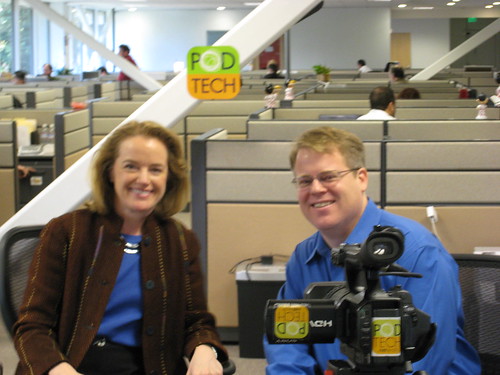
When i found out she was coming i pinged her and asked her if she would be interested in speaking to Robert Scoble for an interview on the Scoble Show- her response was immediate and positive about having the ability to talk to Robert's audience and the following is what we got:
some highlights- (for me because i know the story already!)
25:38-Google video reference - Robert asks about video- interesting specially cause of the recent announcement about Dow Jones and Google Video Ads. Video is a media distribution method that is growing and as a media producer we seem to be paying attention- my customers are asking.
29.30-Robert asks how is Dow Jones being disrupted- Clare's response-which is not a new one but one that lead the Factiva innovation push- competition is healthy and challenges what is going on in the marketplace- - Google challenged us- our response Search 2.0 - power global search with a rich collection and visualization features- competitive challenges accelerate delivering of innovated products to customers.
and my favorite which i talk about all the time- enterprises are made of a huge consumer groups that are creating communities - content delivery tools in the Enterprise must provide the features those user communities expect in their information consumption tools.
Big thanks to Jeremiah as well- he is a Clare fan as well.
Monday, February 12, 2007
FASTforward conference and we won an innovation award: Interview with Lou Paglia
But meanwhile since video is so much simpler to post, i would like to share with you a Video interview i did with Lou Paglia Director & GM, of Core Business for the Factiva products at Dow Jones. Dow Jones was awarded an innovation award for its work with the FAST product on the core products like Search 2.0 that we launched last year that provide a Web2.0 experience for enterprise users. During Thursday's dinner, the award was announced and i also recorded this video of Lou's acceptance speach on behalf of Factiva Dow Jones as he gives thanks to the teams that work so hard on our solutions. During my interview the next day, Lou also hits upon the fact that we are now using our technologies to deliver blog content as an integrated experience. Great stuff!
If you are reading this through a reader or want to see the video in larger format, click here. I am still experimenting with my new video camera and seem to be having a hard time losing video quality on YouTube uploads and think i am going to try another service (please suggest via comments.)
Tuesday, February 06, 2007
Congratulations to Clare Hart for being named One of Women 3.0 Magazine's "Top 100 Women in Corporate America"
 Clare Hart who is an Executive Vice President for Dow Jones & Company, and president, of the Dow Jones Enterprise Media Group which i am now part of was recently named one of Women 3.0 Magazine's "Top 100 Women in Corporate America" .
According to the press release, the list recognizes inspiring women visionaries for the results of their hard work and dedication and includes those executives who have achieved powerful positions based upon their extensive knowledge and professional style. I have known Clare for many years (she was Factiva's CEO) and she certainly is someone that meets that criteria. Congrats!
Over the years as a Factiva employee i was always very proud to work for a company that had a female CEO that was also an industry leader. We were also lucky enough to have female COO. Female leadership and advancement in the corporate world is unfortunately not as frequent as it should be so for inspiration one of the RSS feeds i subscribe to is News On Women which provides almost daily updates on achievements of women in business, science, technology, education and the arts.
Note: the magazine cover is Marissa Mayer from Google not Clare Hart. Also, I couldn't locate the full list of the top 100, but if i do i will link to it on this post.
Friday, February 02, 2007
Jeremiah at Podtech talks to Matt Toll of Dow Jones (Factiva)
During the video Jeremiah asked what Dow Jones was doing in this new media space. Matt did a good job of describing why a lot of the former Factiva people are excited about the Dow Jones acquisition because of certain market opportunities but the recent summaries from Dow Jones CEO Rich Zannino's keynote speech at the SIIA (Software Information Industry Association) Information Industry Summit from Barry Graubart from Alacra and the Shore Communications blog point to the fact that in this "new media" world some of the "old media" folks are gearing up and with that i am glad to be going for the ride. Long, long, long time ago i remember Clare Hart (former CEO of Factiva now EVP at DJ) requesting someone to train the newly arrived Zannino on the new Factiva.com service- at the time i was an Enterprise Consultant working with our top global customers- i got assigned the training task and had to go over to the DJ executive offices to do the training- i wonder if he remembers and if he does, i sure hope he remembers what a great job i did.
Note: I have had a lot of new readers lately, especially with being part of the new Media 2.0 workgroup syndicated feed so although his post happens to be about my employer, i would like to remind my readers that: "The opinions expressed on this site are my own and do not necessarily represent those of my past, future or present employer".
Tuesday, January 30, 2007
Use of Map Mashups in Enterprise Applications
Map mashups are probably the most used if not the most recognized mashups in the consumer world and it is no surprise that they are starting to make an appearance in enterprise applications as well. In the consumer world people create map mashups constantly. The Google Maps Mania blog has an almost daily post on mashups using Google Maps (of specific interest to me would be the fact that the Stabilimento Balneare Bagno Elena has WiFi for example which might come in handy this spring).
Always looking to provide extra value add to our services, late last year Factiva Salesworks provided our users with a global mapping solution using Microsoft's Virtual Earth mapping service which i was very excited to get my hands on.
Using my new video camera (be patient with me this is only my second video with this camera), i recorded this Use Case Scenario of a sales person preparing for a sales trip to Denver. I did this for a client and to show my new colleagues from Dow Jones who were just given access to SalesWorks some of the cool capabilities of an integrated mapping service. (if you are interested in giving this a test drive let me know and i will send you demo access)
Do you know of other cool enterprise map mashup applications? (Salesforce.com has a couple for example) leave them in the comments so i can go take a look.
Monday, January 15, 2007
Jakob Nielsen's Report of the 10 Best Intranets of 2007
On the list this year, there are a couple of customers that i have worked with over the last few years at Factiva Dow Jones (as there was on the 2006 and 2005 lists) but it makes me particularly pleased because this year's winners emphasized an editorial approach to news on the homepage. From the summary:
"Many intranets have long offered news feeds, but this year's winners have taken extra steps to make their news offerings more relevant to employees, both for internal news and for industry-related external news. Labeling and categorization are more extensive than before, and several intranets let users rate and comment on stories."
Editorial workbench solutions for corporate clients have been a very popular solution over the last few years and for companies that do not have resources to hand pick articles, our editorial services have also offered customized news summaries that can be posted to intranets with multiple delivery options like wireless delivery. With information overflow and with the need to provide content specific to the business needs- human 'editors' who have knowledge of the business will always provide the best summarization of news of interest and it is evident based on the usability and added values these intranets provide.
Nielsen goes on to write under the heading "Web Trends Without the Hype" about using Web 2.0 in the enterprise. Richard MacManus over at Read/WriteWeb thinks Nielsen takes "takes an unnecessary potshot" against user rated content. Of course we know that Nielsen is just being Nielsen but i tend to agree with Nielsen- in that:
Employees of the same company have shared goals and interests, they have passed the quality filter of getting hired, and they have their reputations to protect. For all these reasons, ratings and comments from colleagues are likely to be much more useful than those of random blog readers.
In this post last year on what i saw as growing trends in information delivery in the enterprise- "News Summary Applications- 'Socialize and Network with External News" i wrote that there was a need for enterprises to enable ‘participatory consumption’ to socialize and network with targeted external news more within the enterprise. It is good to see that those companies that are taking the lead are being recognized.
Monday, January 08, 2007
Got Content? Will a successful Metadata Strategy help you unlock your content's business value?
 Can you believe it? Officially it has now been two years since i moved to California from the east coast. I have to say that it has been a blast and i have certainly assimilated into the California lifestyle fully! But one of the things i still miss most about being in New Jersey (aside from the pizza and bagels of course) is spending time with my product group back at our corporate headquarters. Every once in a while they come out to visit with clients- but certainly not enough for me to get my fix. So i need to fill my curiosity by reading what is put out there in general internal and external communications, scanning the internal teamsites, playing in the integration sites and asking a lot of questions. That helps with the short and long term product stuff- but what i really like is hearing them talk about content industry trends and what we see in the marketplace.
Tomorrow morning, 8am PST/11am EST i will be getting a little fix by attending a webinar on the business value of a successful metadata strategy and listening to Greg Merkle impart some of his wisdom. Greg is the Associate Vice President of Product Design at Dow Jones and will be leading this webinar. For the past 13 years Greg has been responsible for driving Human Factors and User Interface Design and currently runs the Product Design Group at Factiva Dow Jones.
i am a HUGE FAN of Greg's and have learned a lot from him over the years around building information solutions that address enterprise users' needs.
If you can join us, register here- if you can't or you are reading this after the fact and are still interested we will be providing a recorded version afterwards so drop me a line [daniela[dot]barbosa@dowjones.com] and i will send you the information.
Monday, December 18, 2006
Companies using social media can't just be visitors
I left a comment on his post and i wrote:
"What we did with the social media roundtable that you reference was awesome but it is also pretty scary. So we have engaged in this community of social media enthusiasts one that i had been involved in for a while- mostly 'personal' due to my interest in this 'new' media. Because i haven't really engaged with the Insight product suite since consulting services hasn't been involved that much, i started bringing the product folks into the conversation and they engaged fully and whole heartily- so the whole thing got rolling...now we have some great information that we gathered and we have started a buzz around where we are going and now how do we continue to be engaged above and beyond my blog or glenn's? It takes a lot of work and passionate individuals to maintain what we have started but I think it is very worth while. An interesting conversation is going on per this post once you jump in you need to continue so you don't just act like visitors."
The post i referenced was Jeremiah's recent post on Do companies Cultivate, Harness, Build, Engage, Lead, Visit, Watch, or Join Communities? - before boarding the plane on saturday i opened a couple of browser windows (an offline trick i have been forced to do) including the post that he linked to about Shel Israel's lunch with the Citizen Agency folks. As i read through all their thoughts and comments it was addressing some of the things i have been thinking about post the social media roundtable event. I completely agree with Tara Hunt that if you are going to step into a community you must not play visitor- I of course wanted the out-put of the event to come out immediately- things change so much in a week let along a month. There are some great follow-up posts from the attendees but aside from Glenn's and my quick roundup posts (both of us have been on the road since the event) factiva has a lot of information that we need to share back but it will take some time because the video and audio is being put together back in corporate-the white paper is getting started and the DJ final announcement last week meant that everyone was 'on deck' for integration stuff.
So i won't fret because i know when i get back from vacation things will start to be produced and shared back but figured i would share this as an example of a company (factiva) using social media and how we are continuing with the monitoring social media community and are very conscious that we need to continue what we started. More to follow- of course!
Friday, December 15, 2006
Reuters sale of Factiva final and the Motley Fool thinks Dow Jones is something of a special case within the newspaper world.
 This afternoon it was posted on our internal portal and the press is starting to cover it. The Reuters sale of Factiva is now final. In my factiva alert this afternoon i also got a link to this article that the Motley Fool website thinks Dow Jones is something of a special case within the newspaper world. i agree
Wednesday, December 06, 2006
Social Media Roundtable round-up
It is a great feeling when something that you put a lot of effort and love into goes well. i can honestly say that i am extremely pleased with how the social media roundtable event that we hosted last night turned out. i have a lot of people to thank like my factiva colleagues Glenn Fannick, Matt Toll, Sally Hammond and Saurabh Goorha but the biggest shout out goes to Jeremiah Owyang who:
1.) inspired me to take this on and to use the social media tools and connections i have made to involve key members of the community
2.) volunteered with passion to be our master facilitator and came up with a great exercise to gather the attributes that are the most important to the attendees.
Glenn Fannick who is part of our product development group posted some of his initial thoughts on his blog and i agree that my head is also spinning from all the things we discussed. Today the factiva team spent some time debriefing from the event. Before leaving to go back to the east coast, i managed to convince Glenn to sit in front of the camera and share his thoughts on the outcome of the event and what we intend on doing as next steps. The great thing is that the conversation is already started (see links below).
One of the things that i find to be the most fascinating is that we will have the opportunity to apply some of the metrics that we discussed during our session as to the affect of the social media being produced by this event- our internal PR group will hold us to that. The entire event- about social media-was driven by social media
- it basically started with a conversation on a blog
- we used linking to various blog posts to engage people
- we used a wiki to share event details
So far the output has been the production of social media and attendees are posting on blogs, photo sites and video sites- so how will factiva measure the outcome of this event? We plan on sharing that information back into the community so watch this space.
Current Event Resources:
- Jeremiah's very detailed post from the event including many links to additional resources and the outcome of the important attributes exercise- Factiva Social Media Roundtable helps to answer “What should we measure”
- Jeremy Pepper's -master scriber and insights post Factiva Roundtable and Social Media.
- Chris Kenton's engaging thoughts on Social Media Metrics
- Flickr stream tagged to factivaroundtable
- We will continue to update links and resources from the roundtable wiki, and we have some video and audio that we will be making available as well as a white paper with the findings and the questions raised.
I am skipping town for the next few days heading south for some R&R- i have a lot to think about and chew on and i certainly look forward to reading even more thoughts and engaging questions and conversation on this topic when i get back!
Thursday, November 30, 2006
Factiva Search 2.0 : [corrected] Finalists in Specialist Search Product
 This January we launched a new search experience called Search 2.0 and over the last few releases we have enhanced the experience quite a bit as well an integrated the experience into some of our other products like SalesWorks. Although an information professional by training (yeah i can build a mean boolean query) over the last few months i have found myself turning to the Search 2.0 feature more and more. The results are very relevant, the results page includes visualization that not only provides headlines results but summarizes the results through visualization and allows me to discover themes that i might not have known to search for using keyword and phrase clustering.
Since i am always looking for that information nugget about my customers, new technologies or general business news that might affect the enterprise environment Search 2.0 with my alerts via RSS have been fabulous.
Well the hard work that the product group has put into building this innovative search experience has paid off. This week the International Information Industry Awards took place in London. Hosted by Online Information 2006 and Information World Review, the awards offer the chance for the global industry to recognise the achievements of information teams, information and content management projects, vendors and individual information professionals.
Factiva Search 2.0 was awarded [note corrected on Dec 1st: we are a finalists of] one of the Best Specialist Search Product
* Exalead
* Factiva Search 2.0
* Nexidia Rich Media Search
* Vivisimo
* Trexy.com
Congrats to the product well done- and you have me addicted!
