Showing posts with label flickr. Show all posts
Showing posts with label flickr. Show all posts
Sunday, August 02, 2009
Flickr Slideshow Cures a Bit of Back Home Blues
Although i am lucky enough to live on the coast of California and am privileged enough to be able to walk down to the Pacifica beach and for example watch whales pretty frequently this summer, i still get a bit 'home' sick when i think about being back in Portugal especially because the coast line reminds me so much of where i grew up in Portugal (a bit south of Lisboa in a town called Paço d'Arcos). But a flickr slideshow cured it all this evening. (an early morning walk in 88 photos from our house to the beach pathway from Dec 2007).
Enjoy~
Enjoy~
Wednesday, January 07, 2009
Library of Congress Reports on Flickr Pilot
 [This post is cross-posted on the Synaptica Central Blog]
Last month the Library of Congress released their report on their ongoing Flickr project that i have been very interested in and have written about as the project progressed. From their blog post on the report:
"Only nine months into the Library of Congress’ pilot project placing Library photos on the Web site Flickr, the photos have drawn more than 10 million views, 7,166 comments and more than 67,000 tags, according to a new report from the project team overseeing the lively project."
“The popularity and impact of the pilot have been remarkable,” said Michelle Springer, project manager for digital initiatives in the Office of Strategic Initiatives, who said total views reached 10 million in October. The site is averaging 500,000 views a month, she said, adding that Flickr members have marked 79 percent of the photos as “favorites.”
A summary of some of the outcomes:
- Increasing awareness of the digital photograph collection the Library of Congress (LC) has which has been available for years on the Library's website turning to not only an engaged audience but a lot of referral traffic to the Library's Website. "Feedback of this nature suggests that as a result of this project the Library is reaching new audiences—people who did not or could not find this material on our own site, and people who never thought to look here. "
- Gain a Better Understanding of Social Tagging and Community Input (see below for more details)
- Pilot helped the LC staff gain experience with Web 2.0 online interactions with 'patrons'
I. LC description-based (words copied from the Library-provided record): e.g., titles,
names, subjects, etc.
II. New descriptive words (words not present in the Library-provided description):
- Place: e.g., cities, counties, countries, natural feature names
- Format (physical characteristics of the original photos). Sample tags: LF, large format, black and white, bw, transparencies, glass plate
- Photographic technique. Sample tags: shallow depth of field
- Time period. Sample tags: wartime, WWII, 1912
- Creator name: e.g., photographer’s name
III. New subject words (words not present in the Library-provided description):
- Image (items seen in the image itself). Sample tags: cables, trees, apples, windows, hat, yellow
- Associations/symbolism (phrases and slogans evoked by the image). Sample tags: Rosie the riveter, Norman Rockwell, We can do it!
- Commentary (revealing the tagger’s value judgments). Sample tags: Sunday best,
- proud, dapper, vintage.
- Transcription (transcribing words found in items such as signs, posters, etc., within the photo)
- Topic (terms that convey the topic of the photo). Sample tags: architecture, navy, baseball, story
- Humor (tags intended to be humorous rather than descriptive) Sample tags: UFO, flying saucer
pretty, ugly, controversial
V. Personal knowledge/research (tags that could only have been added based on knowledge or research by the tagger, and that could not have been gleaned solely from the description provided or examination of the photo): For example, the tag murder used on a portrait of someone who was later murdered or tags added for the specific county when that information was not part of the description.
VI. Machine tags (added by the community not Library-supplied): e.g., geotags and Iconclass tags
VII. Variant forms (representing terms already tagged but in a different form, such as synonyms (e.g., WW2, WWII, World War II, worldwarii) or plural/singular differences (e.g., transparency/transparencies)
VIII. Foreign language (tags in foreign languages/scripts, whether they are translations of English-language tags, or new tags)
IX. Miscellaneous (tags that are not readily understood, that provide corrections to LC descriptions or to other taggers (e.g., not peaches), or tags later removed
Some of the Future Tag Analysis Interests (page 29) are also quite interesting such as actually incorporating popular concepts or variants into the LC's own controlled vocabularies (yeah something i advocate in the hybrid approach!), bringing the tags into the LC's search environment, populate bibliographic records with tags (although that have already added the Flickr URL to the "additional version available" field (MARC field 530) in some catalog records which leads users to the appropriate Flickr page that might provide historical information etc. on the image that is vaulable- see sample on page 36).
In the report they also share some of the experiences the staff learned from using Web2.0 tools in interacting with patrons that might be different from the traditional reference desk exchanges (page 37).
The good news? Skip to page 38 of the full report to see the recommendations and conculsions including details of headcount that is necessary for the program to continue and expand. But the report ends with the following good news:
"It should come as no surprise, then, that the Flickr team recommends that this experiment in Web 2.0 cease to be characterized as a pilot and evolve to an expanded involvement in this growing community (and other appropriate social networking opportunities that may arise) as resources permit. The benefits appear to far outweigh the costs and risks. "
The entire set of tags that have been applied can be seen alphabetically or as a tag cloud of the 150 most popular tags.
Many thanks to the Library of Congress staff for taking on this project and continuous sharing their progress through their blog and other resources (see Appendix C) and to the authors of the project report: Michelle Springer, Beth Dulabahn, Phil Michel, Barbara Natanson, David Reser, David Woodward, and Helena Zinkham!
Friday, October 10, 2008
Bringing Pictures Alive: A Storyteller at the Library Of Congress
Watching this video this evening was the most enjoyable thing i did all week. (even if it had been just a regular week when i didn't need something to distract me i think this would have won out!)
I just finished watching Robert Scoble's Getting USA's Treasured Images Onto Flickr video on Scobleizer.tv with Helena Zinkham, who runs the prints and photography division of the Library of Congress. In the video, she talks about how they get images from the library onto Flickr and what that’s done for the library itself.
Since the Library of Congress went live with this project i have been a great fan- and i have been waiting for an update on the status of the project so this video was extremely interesting to me.
Helena is a great story teller- watching the video i felt like i have known her all my life.
She starts off by pointing out that the Library of Congress's (LOC) objective is to preserve knowledge so people can use it and take it beyond the LOC walls- lucky for us.
Part of the conversation is about the actual work to do the digital images (although i thought at one point she mentioned that she was going to show Robert the room but that never comes up in the video. see technical FAQs here if you want to learn more about the how). The LOC's aim is to take the original image and provide a neutral representation- the digital image should look like the actual original photo. They get comments from people who want the LOC to do the colors nicer/brighter/darker- but the LOC is not in the optimization business because that is "very judgmental" Helena says- so they keep the artifact as close to the orginal as possible letting others ("outside the wall") optimize for what they need the photo for such as prints, posters etc.
At one point in the video Helena shows the earliest known photographic portrait of a person which is absolutely beautiful it is of Robert Cornelius ~stunning. (however it is not on Flickr through LOC).
So how did the LOC get to Flickr?
They knew that allowing people to tag content might be useful to get through the over 40,000 pictures that had not been fully cataloged. So they thought about building a web 2.0 application internally for use with the public- but what Flickr brought to the table, was an existing photo friendly, photo loving community. Working with George Oates at Flickr, starting in May 2007 they worked together that summer to put together a process to get the pictures into Flickr.
Flickr had to create a special type of account for the LOC that is now being used by eight public photography archives through their 'The Commons' program - something i did not know existed but looks to have some gems.
The LOC are the stewards of these collections and Flickr had to provide a special Copyright status that means that the Library is unaware of any restrictions on the use of the image.
So what does it mean that they are Bringing Pictures Alive?
Helena talks about the fact that what this has done is bring the collection 'alive' by allowing people to not only add tags- but comments on the pictures that tell personal stories or point out facts about the photo that due to resources catalogers would probably never get a chance to research.
Here is a perfect example from today's new uploads- this picture of Evelyn Nesbit was posted and within hours a colorful story of her life and times developed in the comments.
During the video, Helena tells a story about this picture of Weavers at Work at the The New York Blind Association and this House in Houston where people went beyond identifying the place that shows how indeed this process is bringing value for the LOC as well as the public.
The one thing that Robert doesn't dig into is how they are going to take the tags and comments specifically to enhance the existing catalog. I would have liked to hear a bit more about some of the results of this additional metadata on the collections outside of Flickr- how are they specifically being incorporated back into the original 'artifacts', what work effort is required? How valuable are the current tags? does it really save catalogers time? or does the metadata noise actually cause more work in the long run?
Helena briefly mentions that the LOC have very gifted catalogers (they do!) - but the volume is just too large to be able to catalog down to the level that the flickr users are doing. It does seem that the LOC is 'manually' enhancing their catalogs, for example this comment where the LOC is corrected and states that they would "update the source data and reload the description".
I have no doubt that the LOC will be sharing more of what they have learned about user tagging collections- but to date there seems to be some real value for both the LOC as well as the public!
And one last note, there was some sound issues late in the video with the volume turning up really loud that gave me a startle so beware!
I just finished watching Robert Scoble's Getting USA's Treasured Images Onto Flickr video on Scobleizer.tv with Helena Zinkham, who runs the prints and photography division of the Library of Congress. In the video, she talks about how they get images from the library onto Flickr and what that’s done for the library itself.
Since the Library of Congress went live with this project i have been a great fan- and i have been waiting for an update on the status of the project so this video was extremely interesting to me.
Helena is a great story teller- watching the video i felt like i have known her all my life.
She starts off by pointing out that the Library of Congress's (LOC) objective is to preserve knowledge so people can use it and take it beyond the LOC walls- lucky for us.
Part of the conversation is about the actual work to do the digital images (although i thought at one point she mentioned that she was going to show Robert the room but that never comes up in the video. see technical FAQs here if you want to learn more about the how). The LOC's aim is to take the original image and provide a neutral representation- the digital image should look like the actual original photo. They get comments from people who want the LOC to do the colors nicer/brighter/darker- but the LOC is not in the optimization business because that is "very judgmental" Helena says- so they keep the artifact as close to the orginal as possible letting others ("outside the wall") optimize for what they need the photo for such as prints, posters etc.
At one point in the video Helena shows the earliest known photographic portrait of a person which is absolutely beautiful it is of Robert Cornelius ~stunning. (however it is not on Flickr through LOC).
So how did the LOC get to Flickr?
They knew that allowing people to tag content might be useful to get through the over 40,000 pictures that had not been fully cataloged. So they thought about building a web 2.0 application internally for use with the public- but what Flickr brought to the table, was an existing photo friendly, photo loving community. Working with George Oates at Flickr, starting in May 2007 they worked together that summer to put together a process to get the pictures into Flickr.
Flickr had to create a special type of account for the LOC that is now being used by eight public photography archives through their 'The Commons' program - something i did not know existed but looks to have some gems.
The LOC are the stewards of these collections and Flickr had to provide a special Copyright status that means that the Library is unaware of any restrictions on the use of the image.
So what does it mean that they are Bringing Pictures Alive?
Helena talks about the fact that what this has done is bring the collection 'alive' by allowing people to not only add tags- but comments on the pictures that tell personal stories or point out facts about the photo that due to resources catalogers would probably never get a
chance to research.Here is a perfect example from today's new uploads- this picture of Evelyn Nesbit was posted and within hours a colorful story of her life and times developed in the comments.
During the video, Helena tells a story about this picture of Weavers at Work at the The New York Blind Association and this House in Houston where people went beyond identifying the place that shows how indeed this process is bringing value for the LOC as well as the public.
The one thing that Robert doesn't dig into is how they are going to take the tags and comments specifically to enhance the existing catalog. I would have liked to hear a bit more about some of the results of this additional metadata on the collections outside of Flickr- how are they specifically being incorporated back into the original 'artifacts', what work effort is required? How valuable are the current tags? does it really save catalogers time? or does the metadata noise actually cause more work in the long run?
Helena briefly mentions that the LOC have very gifted catalogers (they do!) - but the volume is just too large to be able to catalog down to the level that the flickr users are doing. It does seem that the LOC is 'manually' enhancing their catalogs, for example this comment where the LOC is corrected and states that they would "update the source data and reload the description".
I have no doubt that the LOC will be sharing more of what they have learned about user tagging collections- but to date there seems to be some real value for both the LOC as well as the public!
And one last note, there was some sound issues late in the video with the volume turning up really loud that gave me a startle so beware!
Wednesday, April 30, 2008
Photo Categorization Different Needs for Different Users
Over the last few days i have come across two separate conversation about taxonomies on Flickr that i thought were interesting. Flickr is a photo (and now video) site that has become increasingly popular yet i still run into people frequently who don't know about flickr (yes, shocks me as well). When i ask what they use to share pictures they mention sites like Snapfish or Kodak Easyshare were the model is still more share and buy then organize. Flickr allows users, especially Pro users who pay $24.95 per year to use a variety of ways to 'organize' their photos by using collections, sets and tags.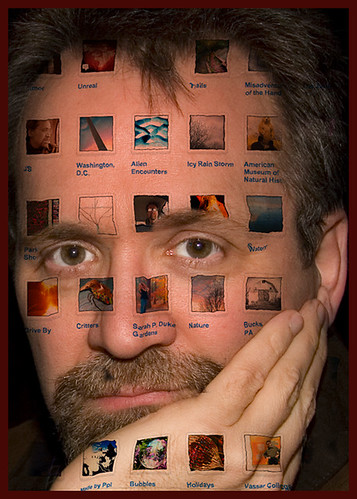
John Suler has an interesting project going on using Flickr about The CyberPsychology of Flickr and his recent addition was about Categorizing Images which came with the photo i include in this post. The project is to encourage discussion on how "people in flickr use photographs and images to express themselves, converse with each other, and form relationships as well as groups" and this addition was focused on how flickr users categorize their pictures.
In talking about personal 'taxonomies' he writes: "The categories you start off with may not work well later on. And the way you organize images for your own personal archive may be different than the collections you create for showing your images to others, as in flickr." In my world of taxonomies, we call this audience centric views- different audiences either by user type, location (e.g. US/UK), or usage purpose, etc.. Well built taxonomies allow this and robust taxonomy management tools enable this. Here is a paper on how the National Library Board of Singapore uses Audience-Centric Taxonomy: Using Taxonomies to Support Heterogeneous User Communities'
The other topic was Keywording for biology/taxonomy/nature photographers using Aperture which i have not used but seems to have a more robust keyword management tool allowing a hierarchy to be built. In the thread Stewart Macdonald highlights one of the things that for example content editors benefit from when a hierarchal taxonomy is presented that allows selection when tagging and that can also automatically expand the user-selected terms using related terms from their taxonomy system (and it does not have to exclusive of free text tags either!).
Stewart writes in response to someone who suggests that he just add keywords and then use search to find photos: "The hierarchy is important to me. If I didn't have nested keywords, I'd have to assign the following keywords individually to any pics of crocodiles:
animal
vertebrate
reptile
crocodile
Crocodylus
Crocodylus porosus
Being able to just assign 'Crocodylus porosus' and have all the 'upstream' keywords included too is a bit quicker.
I am always trying to find 'consumer' examples to illustrate concepts- that although might be different in a corporate environment still help the user understand some of the benefits- so these things and flickr- delight me.
Photo credit : jsuler
Thursday, January 17, 2008
Oh Glorious Library of Congress and Flickr
How the hell am i going to get through all 3,115 and growing photos ?
Via the Library of Congress Blog and Dave Winer's twitter message (how stoked is he because of FlickrFan) - What an AWESOME use of a Flickr Pro account for the Library of Congress...so glad my taxpayer money is supporting that hefty fee of $24.95 per year ;-) (OK it is a partnership so maybe they aren't paying for a Pro account).
Aside from the fact that we all now have access to great quality images f rom the archives that many of us would probably never see, the Library of Congress is not only doing this for our own viewing pleasure and to make Dave Winer's photo display application even cooler when we are procrastinating on Flickr - there is a purpose and very important one.
From their blog post:
If all goes according to plan, the project will help address at least two major challenges: how to ensure better and better access to our collections, and how to ensure that we have the best possible information about those collections for the benefit of researchers and posterity. In many senses, we are looking to enhance our metadata.
Imagine telling these young women "Backstage" at the "girlie" show at the Rutland Vermont state fair in 1941 that in 2008, some random person in San Francisco, looking at the photo in the 'cloud' would tag it with the word tuxedo?
Yes. Using user tagging the Library of Congress wants to enhance their metadata. The October/November 2007- Bulletin of the American Society for Information Science and Technology- Special Section on Folksonomies (multiple articles) had a couple of articles on images tagging by end users that addresses tagging images.
Important facts from their FAQs:
Q: How were the items selected/why did you pick these pictures?
A: We picked two sets of popular images, for which no restrictions on publication or distribution are known, and for which high quality files are available. Because we are also interested in tags and comments on the photos, we picked one set (George Grantham Bain Collection) for which we have minimal identifying information, and another (Farm Security Administration/Office of War Information color photographs) that has some subject indexing.
Calculated choices in order to gather some real use cases for tagging collections. They will be able to compare the usefulness of the tags by matching and comparing a well indexed collection with one that is not.
Q: Will the Library do anything with the tagging info once I add it to the Flickr photos?
A: The Library will decide what to do with data added through Flickr once the pilot is over. Because resources to update catalog records are limited, the Library cannot promise to incorporate contributed data into its own records.
Can't wait to hear what the final outcome is an how Flickr will be able to provide that data back to the Library of Congress to include 'clean' tags back into their systems.
It also seems that each picture has bibliographic information available (although not segmented but only in the notes field) as follows which is probably the typical current 'catalog' record with their controlled vocabulary (shame that Flickr wasn't able to pre-populate at minimum subject tags)
***An important Pilot FAQ on their site:
Q: How long will these photos be available on Flickr?
A: The length of the pilot will be determined by the amount of user interest and tagging activity related to the materials.
Well what are you waiting for? Go check out some great photos and tag your way into metadata history!
Via the Library of Congress Blog and Dave Winer's twitter message (how stoked is he because of FlickrFan) - What an AWESOME use of a Flickr Pro account for the Library of Congress...so glad my taxpayer money is supporting that hefty fee of $24.95 per year ;-) (OK it is a partnership so maybe they aren't paying for a Pro account).
Aside from the fact that we all now have access to great quality images f
rom the archives that many of us would probably never see, the Library of Congress is not only doing this for our own viewing pleasure and to make Dave Winer's photo display application even cooler when we are procrastinating on Flickr - there is a purpose and very important one.From their blog post:
If all goes according to plan, the project will help address at least two major challenges: how to ensure better and better access to our collections, and how to ensure that we have the best possible information about those collections for the benefit of researchers and posterity. In many senses, we are looking to enhance our metadata.
Imagine telling these young women "Backstage" at the "girlie" show at the Rutland Vermont state fair in 1941 that in 2008, some random person in San Francisco, looking at the photo in the 'cloud' would tag it with the word tuxedo?
Yes. Using user tagging the Library of Congress wants to enhance their metadata. The October/November 2007- Bulletin of the American Society for Information Science and Technology- Special Section on Folksonomies (multiple articles) had a couple of articles on images tagging by end users that addresses tagging images.
Important facts from their FAQs:
Q: How were the items selected/why did you pick these pictures?
A: We picked two sets of popular images, for which no restrictions on publication or distribution are known, and for which high quality files are available. Because we are also interested in tags and comments on the photos, we picked one set (George Grantham Bain Collection) for which we have minimal identifying information, and another (Farm Security Administration/Office of War Information color photographs) that has some subject indexing.
Calculated choices in order to gather some real use cases for tagging collections. They will be able to compare the usefulness of the tags by matching and comparing a well indexed collection with one that is not.
Q: Will the Library do anything with the tagging info once I add it to the Flickr photos?
A: The Library will decide what to do with data added through Flickr once the pilot is over. Because resources to update catalog records are limited, the Library cannot promise to incorporate contributed data into its own records.
Can't wait to hear what the final outcome is an how Flickr will be able to provide that data back to the Library of Congress to include 'clean' tags back into their systems.
It also seems that each picture has bibliographic information available (although not segmented but only in the notes field) as follows which is probably the typical current 'catalog' record with their controlled vocabulary (shame that Flickr wasn't able to pre-populate at minimum subject tags)
Delano, Jack,, 1914-, photographer.
"Backstage" at the "girlie" show at the Vermont state fair, Rutland
1941 Sept.
1 slide : color.
Notes:
Title from FSA or OWI agency caption.
Transfer from U.S. Office of War Information, 1944.
Subjects:
Vermont State Fair--(1941 :--Rutland, Vt.)
Fairs
Entertainers
United States--Vermont--Rutland
Format: Slides--Color
Rights Info: No known restrictions on publication.
Repository: Library of Congress, Prints and Photographs Division, Washington, D.C. 20540 USA, hdl.loc.gov/loc.pnp/pp.print
Part Of: Farm Security Administration - Office of War Information Collection 11671-3 (DLC) 93845501
General information about the FSA/OWI Color Photographs is available at hdl.loc.gov/loc.pnp/pp.fsac
Persistent URL: hdl.loc.gov/loc.pnp/fsac.1a33920
Call Number: LC-USF35-50
***An important Pilot FAQ on their site:
Q: How long will these photos be available on Flickr?
A: The length of the pilot will be determined by the amount of user interest and tagging activity related to the materials.
Well what are you waiting for? Go check out some great photos and tag your way into metadata history!
Subscribe to:
Posts
(
Atom
)
