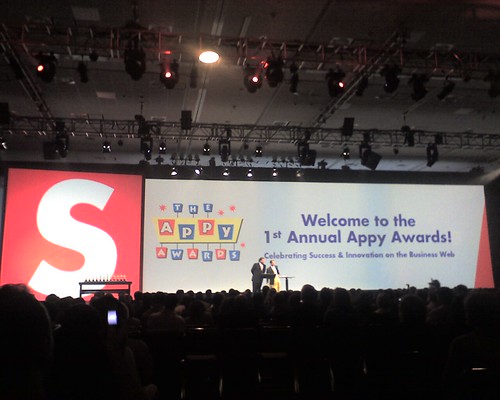
Last week i attended the Office 2.0 conference where the topic of collaboration in the enterprise was a main topic across all the Office 2.0 products and services we looked at. Sure there was a lot of conversations about the technologies- (multitenancy, issues of synchronization and data migration, connectivity, etc)- that will drive the Office 2.0 experience, but we know that without user uptake and participation the coolest and best technology supported tools will not provide the value that these vendors propose to provide in the enterprise. I have been going to KM conferences and reading about collaboration struggles in the Enterprise for years and the issue seems to be the same and one that was discussed last week- if we build it will they come? And if they come- will it stick?
How do we get people to collaborate and to sustain levels of collaboration throughout their careers at an enterprise? What is in it for them? What tools will the new digital natives coming into the enterprise need to be successful and how can we grab the knowledge that is about to walk out of the door with the baby boomers? These questions aren't new but what is being described as Web 2.0 in the enterprise could possible be a new way to try to address these issues.
Back in May i posted about social bookmarking in the Enterprise that lead to some very interesting conservations and the topic of social bookmarking in the enterprise has remained high on my list . Last week, while getting a tour of the tool, I had a chat with Puneet Gupta, CEO of ConnectBeam a new player in the social collaboration enterprise space.
Some folks in the Enterprise shriek when they hear terms like folksonomies- which can be one of the outputs of a social bookmarking tool. I don't claim to be an expert. LibraryClips has a good collection of links that addressed this topic last year that you should look at if you are interested in the folksonomy-taxonomy discussion. I spoke to Puneet Gupta and he certainly doesn't come about as someone who believes that Connectbeam and other tools out there that are targeting the enterprise are looking to replace enterprise taxonomies-augment them, yes- make them more valuable, yes- drive collaboration, yes.
From what i heard, he like others are trying to build a 'passable bridge' from what people are calling enterprise 1.0 to enterprise 2.0 (yeah don't wince)- workers do it on a daily basis with the tools they are turning to (like enterprise wikis and blogs that continue to be 'mashed-up' with enterprise applications)- Enterprises can't fight that and an enterprise metadata tool (or whatever you want to call it) that is able to take both worlds could be the needed suspension cables that flex the bridge when the wind blows yet keeps it passable and solid bi-directionally. As Peter Morville states in Ambient Findability (pg.139) "Ontologies, taxonomies, and folksonomies are not mutually exclusive. In many contexts, such as corporate web sites, the formal structure of ontologues and taxonomies is worth the investment. In others, like the blogosphere, the casual seredipity of folksonomies is certainly better than nothing. And in some contexts, such as intranets and knowledge networks, a hybrid metadata ecology that combines elements of each may be ideal."
Let's imagine that social bookmarking in the enterprise will take off and become accepted and widely adopted and then let's look at some of the disadvantages of Social bookmarking listed in Wikipedia. Then think about how established processes and tools can augment end-user collaboration tools like social bookmarking. The disadvantages listed include:
- no standard set of keywords (also known as controlled vocabulary)-
- no standard for the structure of such tags (e.g. singular vs. plural, capitalization, etc.)
- mistagging due to spelling errors
- tags that can have more than one meaning
- unclear tags due to synonym/antonym confusion
- highly unorthodox and "personalized" tag schemas from some users
- no mechanism for users to indicate hierarchical relationships between tags (e.g. a site might be labeled as both cheese and cheddar, with no mechanism that might indicate that cheddar is a refinement or sub-class of cheese)
So some questions:
-can a taxonomy co-exist with a 'folksonomy' that is user produced through an enterprise social bookmaking tool?
-what would (or does) that look like?
-what would the role of a taxonomy/ontology/metadata 'manager' or similar roles look like?
Labels: social bookmarking, social bookmarking connectbeam, tagging